Archive:Domesday Book
Archives > Archive:Land Records > Domesday Book
Overview
Domesday Book (also known as Domesday, or Book of Winchester), was the record of the great survey of England completed in 1086, executed for William the Conqueror. The survey was similar to a census by a government of today. William needed information about the country he had just conquered so he could administer it. While spending the Christmas of 1085 in Gloucester, William "had deep speech with his counsellors and sent men all over England to each shire ... to find out ... what or how much each landholder had in land and livestock, and what it was worth." One of the main purposes of the survey was to find out who owned what so they could be taxed on it, and the judgment of the assessors was final — whatever the book said about who owned the property, or what it was worth, was the law, and there was no appeal. It was written in Latin, although there were some vernacular words inserted for native terms with no previous Latin equivalent and the text was highly abbreviated. When the book took the name "Domesday" (Middle English spelling of Doomsday) in the 12th century, it was to emphasize its definitiveness and authority (the analogy refers to the Christian belief of a Last Judgment).[1]
Several entries pertain to the ancestors of the Whitneys and to the regions they would later inhabit.
Note: TRE is an abbreviation for Tempore Regis Eduardi, "The time of King Edward".
Whitney
At the time of the Domesday survey, the area known as Whitney was owned by the King and the church. It had not yet been granted to the family which would later take its surname from this location.
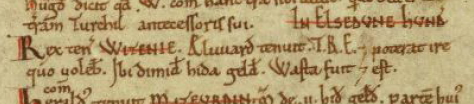
- IN ELSDON HUNDRED
- The king holds WHITNEY. Alweard held it TRE, and could go where he would. There is half a hide paying geld. It was and is waste.
- Source: Great Domesday Book Folio 181r


- IN ELSDON HUNDRED
- The church itself holds WHITNEY, and Harold [holds] of it. There are 4 hides paying geld. They are and were waste; yet they render 6s.
- Source: Great Domesday Book Folio 182v

Wigmore
According to the following entry, Turstano Flandrensi was given land called Downton on the Rock by William the Conqueror. This land was near Wigmore Castle, and why Turstan was also called Turstan de Wigmore.
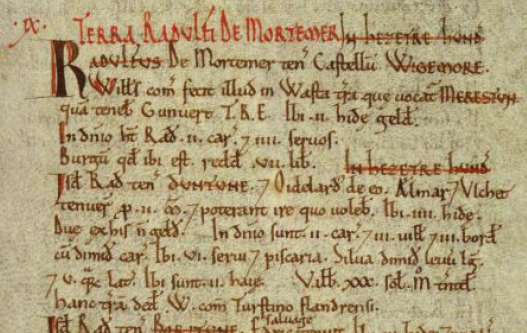
- IX. THE LAND OF RALPH DE MORTIMER
- IN "HEZETRE" HUNDRED
- RALPH de Mortimer holds WIGMORE Castle. Earl William erected it on the waste land which is called "MERESTUN" [in Wigmore], which Gunnfrothr held TRE. There are 2 hides paying geld. In demesne Ralph has 2 ploughs and 4 slaves. The borough which is there renders 7l.
- IN "HEZETRE" HUNDRED
- The same Ralph holds DOWNTON ON THE ROCK , and Oidelard [holds] of him. Almær and Ulfkil held it as 2 manors and could go where they would. There are 4 hides. 2 of them do not pay geld. In demesne are 2 ploughs; and 3 villans and 3 bordars with half a plough. There are 6 slaves, and a fishery, [and] woodland half a league long and 5 furlongs broad. There are 2 enclosures. It was worth 30s ; now as much. This land Earl William gave to Turstin the Fleming.
- Source: Great Domesday Book Folio 183v

Lands of Alvred of Marlborough
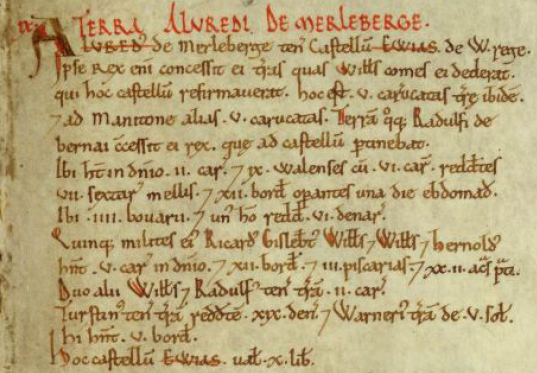
- IX. THE LAND OF ALVRED OF MARLBOROUGH
- ALVRED of Marlborough holds the castle of EWYAS HAROLD of King William. For the king himself granted to him the lands which Earl William, who had refortified this castle, had given him; that is, 5 carucates of land there and another 5 carucates at Monnington. The king also granted him the land of Ralph de Bernay which used to belong to the castle. There he has in demesne 2 ploughs; and 9 Welshmen with 6 ploughs rendering 7 sesters of honey, and 12 bordars working 1 day a week. There are 4 oxmen and 1 man paying 6d.
- His 5 knights, Richard, Gilbert, William, and William and Hernold, have 5 ploughs in demesne, and 12 bordars, and 3 fisheries and 22 acres of meadow.
- Two others, William and Ralph, hold land for 2 ploughs. Turstin holds land rendering 19d , and Warner land rendering 5s. These men have 5 bordars.
- This castle of Ewyas Harold is worth 10l.

According to the following record, Alvred's daughter held the land at Pencombe. This land remained connected to the Whitney family for centuries.
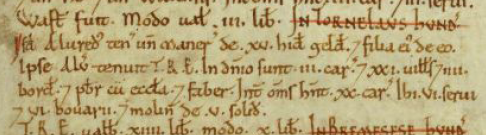
- IN "TORNELAUS" HUNDRED
- The same Alvred holds 1 manor of 15 hides paying geld [Pencombe], and his daughter [holds] of him. Alvred himself held it TRE. In demesne are 3 ploughs; and 21 villans and 4 bordars, and a priest with a church, and a smith. Among them all they have 20 ploughs. There are 6 slaves and 6 oxmen, and a mill rendering 5s. TRE it was worth 14l ; now 10l.

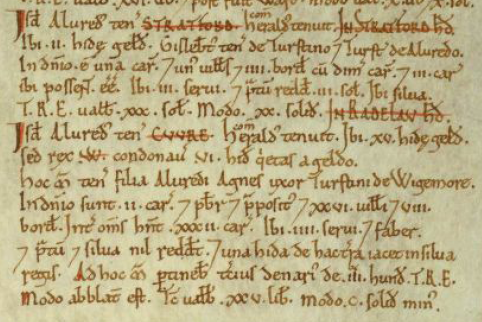
- IN STRETFORD HUNDRED
- The same Alvred holds STRETFORD. Earl Harold held it. There are 2 hides paying geld. Gilbert holds of Turstin, and Turstin of Alvred. In demesne is 1 plough; and 1 villan and 4 bordars with half a plough, and there could be 3 ploughs. There are 3 slaves, and meadow rendering 3s. There is woodland. TRE it was worth 30s ; now 20s.
- IN RADLOW HUNDRED
- The same Alvred holds MUCH COWARNE. Earl Harold held it. There are 15 hides paying geld, but King William allowed 6 hides quit from geld. This manor Alvred's daughter Agnes, wife of Turstin of Wigmore, holds. In demesne are 2 ploughs; and a priest and a reeve and 26 villans and 8 bordars. Among them all they have 32 ploughs. There are 4 slaves and a smith, and the meadow and woodland render nothing, and 1 hide of this land lies in the king's woodland. To this manor belonged the third penny of 3 hundreds TRE; now it has been withdrawn. Then it was worth 25l ; now 100s less.

- Source: Great Domesday Book Folio 186r
References
1. Wikipedia contributors. Domesday Book. Wikipedia, The Free Encyclopedia. November 18, 2006, 23:17 UTC. Available at: http://en.wikipedia.org/w/index.php?title=Domesday_Book&oldid=88701470. Accessed November 18, 2006.
Copyright © 2006, Tim Doyle and the Whitney Research Group.
