Difference between revisions of "Transcription Conventions"
From WRG
Jump to navigationJump to search| Line 27: | Line 27: | ||
** "English Handwriting 1400-1650" (great book with lots of example manuscripts with transcriptions) | ** "English Handwriting 1400-1650" (great book with lots of example manuscripts with transcriptions) | ||
** "Latin Palaeography, Antiquity & the Middle Ages" (one chapter has an in-depth description of the abbreviations used in Latin, many of which were carried down and used in the English manuscripts) | ** "Latin Palaeography, Antiquity & the Middle Ages" (one chapter has an in-depth description of the abbreviations used in Latin, many of which were carried down and used in the English manuscripts) | ||
| + | ** "Revised Medieval Latin Word-List from British and Irish Sources with Supplement" | ||
| + | ** "The Comprehensive Genealogical Feast Day Calendar" | ||
| + | ** "Introduction to Manuscript Studies" | ||
| + | ** "The Court of Common Pleas in Fifteenth Century England, A Study of Legal Administration and Procedure" | ||
| + | |||
| + | ** "A Handbook of Dates for Students of British History" | ||
Revision as of 02:43, 14 August 2008
The Whitney Research Group website uses the following transcription conventions:
Transcription Conventions
- Non-standard spellings are left as they are in the document.
- Abbreviations are expanded, except where the abbreviation is common knowledge, such as Mr. for Mister.
- When abbreviations are expanded, the missing letters are placed in [ ] brackets.
- Crossed out words are designated
like this. - [ ] is used to designate any conjectural reconstructions of the text supplied by the transcriber
- & is retained as is, even in various versions
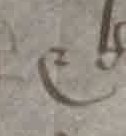
- Example - Tironian 'et':

- Where letters or words have not yet been transcribed, they are replaced by approximately the same number of underscores as there are letters missing.
Common Abbreviations
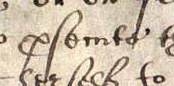
- The letter "p" with a horizontal line through the descender is an abbreviation for "per-", "par-", "pre-", or "pro-"
- Example - ""p[ro]secute":

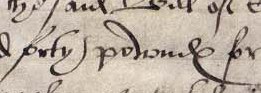
- A long sweeping "e" at the end of a word is an abbreviation for "-es" or "-ies"
- Example - "forty pownd[es]":

- A horizontal line over a word designates missing letters.
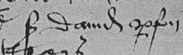
- A downward and backwards stroke through a long s stands for "ir", "er", or "ur", and this abbreviation alone means "Sir"
- Example - "S[ir] David p[ar]son":

- Other abbreviations can be found in the book "Latin Palaeography - Antiquity & the Middle Ages"
- See also
- Paleography: Scribal Abbreviations
- Contractions and Suspensions
- English Handwriting 1500-1700, An Online Course, Transcription Conventions
- Court-hand Restored: Or, The Student's Assistant in Reading Old Deeds, Charters, Records, etc.
- "English Handwriting 1400-1650" (great book with lots of example manuscripts with transcriptions)
- "Latin Palaeography, Antiquity & the Middle Ages" (one chapter has an in-depth description of the abbreviations used in Latin, many of which were carried down and used in the English manuscripts)
- "Revised Medieval Latin Word-List from British and Irish Sources with Supplement"
- "The Comprehensive Genealogical Feast Day Calendar"
- "Introduction to Manuscript Studies"
- "The Court of Common Pleas in Fifteenth Century England, A Study of Legal Administration and Procedure"
- "A Handbook of Dates for Students of British History"
